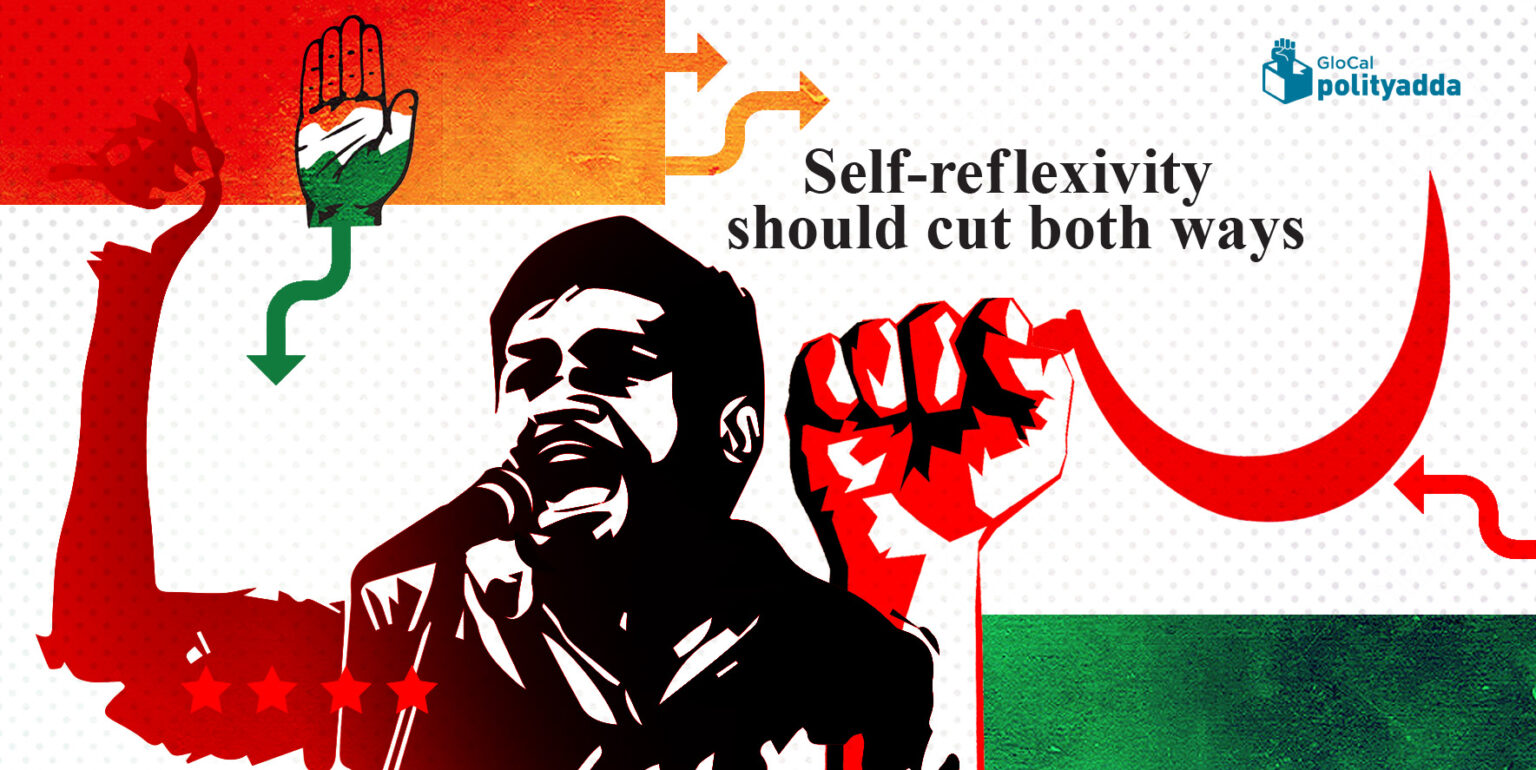
Cover Art: Prasenjit Bera
On 28th September 2021, Kanhaiya Kumar, the former National Executive Council member of the Communist Party of India, joined the Indian National Congress, alongside Jignesh Mevani, an independent MLA from Gujarat. Kumar had initially risen to prominence as a student leader from the Jawaharlal Nehru University and the president of its Student Union, when the students of the varsity led resistance against Police atrocities and sedition charges on students. The charges were framed against alleged organisers of an event commemorating the second anniversary of Afzal Guru. He later established himself as one of the most vocal and celebrated young Turks from the Left. He was a candidate from Begusarai in India’s 2019 General Elections, an uncommon phenomenon in a leftist pantheon, given to its bureaucratic ratifications and factionalism. This was also seen by many as the oldest Communist Party in India (CPI) bowing to the popular demand to see as candidate the one many believed would change their fortunes. And rightfully so, as not just the CPI, but Kumar with his impassioned oratory left disgruntled millennials and ever hopeful boomers equally enamoured of him. And not just his organisation All India Student Federation (AISF) and parent party CPI, from the Communist Party of India (Marxist) – CPIM to Communist Party of India (Marxist-Leninist) Liberation – CPIML Liberation, everyone seemed to be riding on the ‘Kanhaiya’ wave to public memory. It was almost akin to Prime Minister Modi’s rise to superstardom, the new age messiah of regalvanised “Hindutvavadis”, who continues to make it to prime time television news, even with sartorial changes. Kanhaiya Kumar was able to tap into mass media, at a turning point in Indian politics, when availability of cheap internet meant that just as its public sphere was being reshaped by social media performativity, its politics was becoming increasingly Americanised, that is individual centric and speeches televised. What happened on 28th September 2021, has obviously left many disappointed. One interesting critique was penned by Kavita Krishnan, Secretary of the All-India Progressive Women’s Association. Krishnan is also a member of the politburo of the CPIML Liberation. This article offers a response to Kavita Krishnan’s critique of Kanhaiya Kumar’s politics. Without defending Mr. Kumar, the author hopes this would be helpful in making sense of why the left (including the CPIML Liberation) has failed to keep its flock together and why the lure of liberalism is something which afflicts Left parties as much as its cadres.
- Kavita Krishnan refashions Gandhi as somebody distanced from the Congress in later life. Krishnan essentially tries to pass off her political revisionism as history. History is based on empirical evidence and not guided by political imagination. Krishnan makes the same mistake as Kanhaiya or even Modi, when they try to rattle off prevalent myths as history. Myths prevalent in left and liberal ecosystems are in no way superior to myths prevalent in right wing ecosystems. Gandhi’s belief in antistatism finds mention even in Hind Swaraj (1909). Therefore, distancing himself from the ruling dispensation is born out of his conviction against Westminister style of administering Free India. In his last letter to Nehru written on 18th January 1948, Gandhi had urged the then Prime Minister to continue to be the guiding light. Also, according to V Kalyanam, Gandhi’s personal secretary, Gandhi had an extended meeting with Sardar Patel, India’s then Home Minister, even on 30th January, 1948, the day he was shot and killed by Nathuram Godse. That aside the CPIML Liberation eulogising Gandhi is harakiri of sorts. Dipankar Bhattacharya, her party’s general secretary has repeated ad nauseum that their party has tried to remain true to their Charu-Kanu roots, with some obvious criticism of the violence of the armed revolution days. “CPI(ML) fought agaist both sweeping generalization/vulgarization of the forms of struggle that had come to be known as Naxalism and pedantic and opportunist denunciation of the basic revolutionary content of Naxalism in the name of rectification of past mistakes”. Let alone balancing erstwhile Naxalism and later day Maoism with Gandhian perspectives, that Mao, a fervent anti-intellectual as well as anti-Leninist was celebrated as a liberator exposes how the Left’s readings of the past are as ahistorical as the history tracts circulated on whatsapp shakhas. While Charu Majumdar and Kanu Sanyal wouldn’t have access to the research which has since posited the antiMarxist nature of Mao Zedong’s thought, but to even suggest he was an ally of the subjugated people in India, his initial role in thwarting Japanese imperialist tendencies notwithstanding, is counterfactual at best and fanciful at worst. Mao remained an imperialist throughout his life, while Lenin was an anti-imperialist, a messiah for the third world, who believed in the right of ethno-linguistic groupings to form separate nationalities, even to the angst of many of his contemporaries (Soviet chauvinists). Indian Maoist movements’ murderous tendencies towards working classes who would be suspected of being police informants, misguided understanding of the nature of the Indian state and its peasantry, meant that Maoist groups paid lip service to the emancipatory maxim of Marxist-Leninist principles, while adopting the totalitarian armed vanguardism of Maoist China, itself a bastardisation of Marxist-Leninist ideas. Without getting into further detail about Mao’s own sketchy reading (if at all?) of Marxist Leninist thought, Vinod Mishra and the party had maintained that Gandhi’s “methodology of invoking Hindu symbols, particularly Ram rajya in the freedom struggle”, had been the “prime cause for Muslim alienation”. Has the official CPIML Liberation stand on Gandhi changed since?
- Post the Vinod Mishra years, the CPIML Liberation has had only one general secretary – Dipankar Bhattacharya. Democracy eh, Comrade?
- All India Students Association (AISA) affiliated to the CPIML Liberation has many of its leaders’ defect, in search of greener pastures. In fact, by some unofficial counts AISA has seen the most defections when it comes to former student leaders from the Jawaharlal Nehru University. Shehla Rashid, who also rose to prominence during February 2016, deserted AISA for former IPS Shah Faisal’s fledgling party – Jammu and Kashmir Peoples Movement, after initial reports of joining the Aam Aadmi Party (AAP). Faesal has been praising Narendra Modi and Amit Shah for a while now and might be appointed advisor to Lt. Governor of Jammu and Kashmir. Former AISA leader Akbar Chowdhury is working with the corporate poll managing body I-PAC. Former Presidents Mohit Pandey and Sandeep Singh are both in the Congress with the latter working directly for the Gandhis. The inordinate amount of attention on Kanhaiya Kumar’s shift to Congress does give the impression the CPIML Liberation sees it as a lost opportunity at piggybacking on his popularity. The CPIM and even the CPI did not go beyond a tweet or a brief response when approached by the legacy media.
- Kumar has always taken a clear stand on issues which leave the mainstream left in a quandary. He has maintained Kashmir is an integral part of India. This author still believes in the promised plebiscite, while acknowledging the impossibility of it post the violence on the Kashmiri Pandits and their subsequent exodus. However, points must be given to Kanhaiya for his steadfastness and clarity, while the Left has neither been able to support a referendum, nor openly support a more “reformist” stand like Kanhaiya’s. Why blame an individual for flipflops, when the mainstream left in India has been engaging in political summersaults since their very founding?
- CPIML Liberation, despite overtures by the CPIM, including invitation to address the joint convention from Sahid Minar, fielded candidates against Left Front & Congress’ Sanjukta Morcha in 2021 Vidhan Sabha elections in West Bengal. Krishnan, Bhattacharya and their ilk claimed that the Trinamul Congress (TMC) and the Bharatiya Janata Party (BJP) could not be equated. Since that fateful election, it wouldn’t be hyperbole to write that every fortnight one BJP leader has found their way back to TMC, while some other TMC leader has taken shelter with BJP. And this is not mere appropriation of aya ram gaya ram politics. One need only look at the number of Rashtriya Swayamsevak Sangh (RSS) affiliated schools that were given registration since Mamata Banerjee took over as CM and her own stand on differentiating between RSS and BJP, to rubbish Kavita Krishnan and CPIML Liberation’s stand on TMC. Journalists from Bengal are aware that the RSS has always been comfortable with Mamata, and now that the Muslims of Bengal have no other alternative but to vote for Mamata, faced by the bogey of the BJP, it is an ideal situation for the RSS. Historically, the RSS has always been averse to the idea that the Bharatiya Janata Party can be the only defacto party representing the electoral fortunes of India’s Hindus. In fact, the RSS in Bengal, sources suggest, have begun to withdraw their grassroots manpower support to the BJP political machinery, in favour of a now performative and devout “Hindu” in Chief Minister Mamata Banerjee. Delhi CM Arvind Kejriwal has been looking for a similar electoral realignment for a while now. In Bengal, the CPIML Liberation tried to seize the opportunity by fielding its candidates against the Left led “secular” front, to cash in on Left sympathisers possibly disenchanted with Left Front stand of equating the BJP and Mamata’s TMC, using its familiar “authentic left” strategy. Why then should Krishnan accuse an individual of opportunism? Might I suggest some soul searching?
- CPIML Liberation did not think twice before allying with the Rashtriya Janata Dal (RJD) in 2020, despite its history of having patronised the Ranvir Sena. Would Chandrasekhar have agreed with Dipankar Bhattacharya, that to safeguard democracy it was necessary to ally with the party of Mohammad Shahabuddin and Sadhu Yadav. Why the holier than thou attitude when it came to West Bengal elections in 2021?
- Kanhaiya Kumar had his political moorings in the Communist Party of India, which was branded as bourgeois reformist even by the CPIM, before the split of 1964 for its support to a National Front with the Congress. This, coming from the same CPIM that the CPIML Liberation routinely diagnoses as being afflicted by a particularly debilitating case of parliamentary cretinism, must have been stark for the times. How has Kumar’s politics changed then? It seems that most of the left parties wanted to piggyback on Kumar’s success as an orator, and with Indian politics becoming more and more Americanised, that is individual centric and televised, they see Kumar’s exit as a lost opportunity.
- The Congress tradition has accommodated many broader left democratic factions over the years since the P N Haksar led exodus from the CPI during Indira Gandhi’s regime. If Rahul Gandhi is wise enough, he would now go back to leading the party like his mother Sonia Gandhi, and project the two self-made men – Mevani, a Dalit, and Kanhaiya, an OBC, as leaders of Congress’ future legislative fortunes. This would also deflect attention from Rahul Gandhi, whose gaffes have continued to fuel the BJP’s fortunes amongst the urban electorate, and might end up benefiting the Congress in state elections as well. Does the critique stem from Kavita Krishnan’s apprehension, that the major left parties, including CPIML Liberation, still have no contenders to challenge Modi in personality driven Lok Sabha elections, while Congress might have just found themselves two?
- Both the CPIML Liberation and the CPIM have been afflicted with a heavy dose of liberalism over the last decade in trying to appeal to millennials who are easy to reach through social media. That social media is a double-edged sword, with ideological performativity covering up dictates of realpolitik, is something the left chooses to ignore at its own peril. The CPIML Liberation, a party which was riding the social media visibility wave better than the other parties from the mainstream left, chose to ignore all that in its recent posturing on Tiktok ban, etc., despite Facebook leaks suggesting that industry insiders knew the kind of debilitating effects social media has had on teens by establishing a culture of validation as rite to passage. In her critique Krishnan writes Kumar is wrong to focus on bread and butter issues, and suggesting communal issues are a diversion, as these are central to “fascist” politics of the day. However, this is again born of a lack of historical understanding. While Krishnan’s analysis of Fascism and its characteristics are sound, the problem lies in ignoring Global Finace Capital and its proclivity to foist the bogey of Fascism as a check against emerging popular left democratic movements. The bogey of Fascism has historically led to years of uncertainty from which liberal capitalism has emerged stronger, cementing a status quo through popular mandate from people frightened of veering leftwards, should lack of a strong centre or instability bring in the Fascists again. Infact in the neoImperialist phase, through the emergence of a unipolar world and finance capital led globalisation, the bogey of fascism has primarily served this function of endearing people to liberal centrist politics, through individual “freedom” and mobility afforded under capitaism, relative stability and fetishising choice. This has historically done more damage to class consciousness and mass organisation than fascism. This is not to say that fascists have not gone after the left and decimated it in most places where it usurped power but Kumar is right in suggesting that the national bourgeoisie can still pull the rug from under the fascists feet because fascists are not their natural allies. Instances of Fascism or protofascism also emboldens and bring parties with similar ideologies close, something which is rare under neoliberalism. Hence, Kumar’s single minded focus on bread and butter issues is a sensible political tactic. On issues of communalism and state violence there is no party in India, which has ruled for atleast a 5 year term in a state or at the centre, that is not guilty. From Krishnan’s critique it is clear that the mainstream left in India continues to undermine the threat from neoliberalism and the national bourgeoisie. Interestingly Kumar could have been taken to task over the very bread and butter issues alone, which might now be difficult to champion as a member of the Indian National Congress. And it is in this light that the lament over Kanhaiya Kumar’s desertion seems surprising. Despite Kumar’s obvious oratorial skills, how much of that would have helped revive the Left’s fortunes? If it wouldn’t then why spent hours dissecting it? Is it because Kumar’ exodus is a hotly debated topic on social media that one needs to latch on to?
- Kanhaiya Kumar found it difficult in CPI, if reports are to be believed, due to D Raja and CPI central committee’s push for familiar faces at the top and Tejaswi Yadav blacklisting him due to fear of losing out in Bihar’s battle of public perception. Kavita Krishnan and her party could have reposed faith in Kumar during the Bihar polls, and suggested to Tejaswi that to isolate Kumar and victimise him, to safeguard his dynastic legacy, is not something any of the left parties would aid in. Why did Kavita Krishnan and her comrades not take a stand then and support a comrade, rather than let one slide for immediate electoral gains? If the cause was more important than the individual then, why cry over spilt milk now?
If for Krishnan, Kanhaiya Kumar’s political roadmap is the proverbial netineti to arrive at an antifascist politics of the present, then it is time she includes much of the CPIML Liberation’s recent misadventures and summersaults
Rohit Dutta Roy
Rohit Dutta Roy is a Doctoral scholar at the Faculty of History, University of Cambridge. He began his doctoral research at Cambridge after completing an MPhil in Modern History from the Centre for Historical Studies, Jawaharlal Nehru University. Rohit has First Class BA and MA degrees in Comparative Literature from Jadavpur University, and a First Class Master’s in History from the University of Delhi. His stories on politics and policy have appeared in The Wire, Newslaundry and The Citizen. Rohit writes on the everyday political, policy history, identity formation and governmentality.